Calculate the expected value for a probability model.
Use expected value as a tool to make decisions about games, investments, and other ventures.
Expected value is a weighted average. It has many applications, from insurance policies to making financial decisions, and it’s a key concept in understanding risk and reward.
Subsection5.3.1Expected Value
The expected value is the average gain or loss of an event if the procedure is repeated many times. To help get a better understanding of what expected value is and how it is used, consider the following scenario:
You are commissioned to design a game for a local carnival. Your proposed game will have players roll a six-sided die. If it comes up 6, they win $10. If not, they get to roll again. If they get a 6 on the second roll, then they win $3. If they do not get a 6 on the second roll, they lose. With the game design complete, you now need to decide how much the carnival game owner should charge players in order to make a profit over the long run.
To make a profit, the carnival needs to know how much they will pay in winnings, on average, over the long run and charge more than that. In other words, they must charge more than the expected value of the game.
One way to organize the outcomes and probabilities is with a probability model. A probability model or probability distribution is a table listing the possible outcomes and their corresponding probabilities. The outcomes will be the amounts a player can win, and we will calculate the probabilities using what we have learned about theoretical probability.
As we have seen with complements, probabilities in a probability distribution must add to 1, so that is important to check. Here is the probability model for the carnival game:
Outcome
Probability
Value
Roll a 6 in one roll
\(\frac{1}{6}\)
$10
Roll a 6 on the second roll but not the first
\(\frac{5}{6}\cdot\frac{1}{6}=\frac{5}{36}\)
$3
Do not roll a 6 in two rolls
\(\frac{5}{6}\cdot\frac{5}{6}=\frac{25}{36}\)
$0
We observe that \(\frac{1}{6}+\frac{5}{36}+\frac{25}{36}=1\text{.}\) Because the probabilities add to one, we know that all possible outcomes have been accounted for and our table is complete.
Imagine running this game repeatedly. On average, for every 36 times the game is played, the player will win $10 six times, win $3 five times, and win $0 the remaining 25 times. This results in a total winnings of
in 36 plays. Therefore, the winnings average out to \(75\div36\approx $2.08\) per play. This is the expected value if the game is free to play!
You may have noticed that we started by multiplying each probability by 36 and in our last step we divided the result by 36. Because of the distributive property, those operations can be eliminated. Thus, a more efficient way to calculate expected value is to multiply the value corresponding to each outcome by the chance it will happen and add the products together.
In the long run, players can expect to win $2.08 per game. This also means that the carnival owner will be paying out an average of $2.08 per game! Since the carnival owner would rather not lose money, we need to make sure to charge players enough to offset the average payout.
If the carnival owner charges exactly $2.08 to play, the game is considered a fair game since the net expected winnings would be $0. In a fair game, the player isn’t expected to win anything, nor is the owner expected to earn anything over the long run. However, if the carnival owner charges the player more than $2.08 to play, they will earn money over the long run.
Suppose you suggest charging $5 to play. We can determine the net expected value by subtracting the $5 the player has to pay from their expected winnings. This gives us:
With the price set at $5 per play, the player can expect to lose an average of $2.92 per play and the carnival owner can expect to earn an average of $2.92 per play.
Note that the expected value can be calculated from the perspective of either the player or the carnival owner, and the signs will be opposite. If the expected value is negative for the player, it is positive for the carnival owner, and vice versa. In this case, the expected value is negative for the player and positive for the carnival owner.
Expected Value.
Expected value is the average amount of gain or loss in a game, experiment, investment, or other venture.
To calculate expected value, multiply the probability of each outcome by its corresponding value and add the products. If there are any costs associated with the game, subtract them.
Example5.3.1.
Pick4 is a game by the Oregon Lottery that costs $1 to play. In this game you pick 4 numbers in a specific pattern. If you get the exact sequence, you can in theory earn a lot of money. Suppose that the payouts are as follows. Determine the player’s expected net winnings.
Prize ($)
Probability
$250
\(\sfrac{1}{417}\)
$500
\(\sfrac{1}{1833}\)
$1000
\(\sfrac{1}{1667}\)
$1500
\(\sfrac{1}{2500}\)
Solution.
This table is not quite a complete probability distribution since it is missing one important outcome: when the player loses. In that case the prize is $0. We need to add a line for this. The prize for this missing outcome is $0, and since losing is the complement to winning something, the probability will be:
Adding this information to the table gives a complete probability distribution. Now we can see that players are going to lose more than 99% of the time, so the expected value will be heavily weighted toward winning $0.
Therefore, the player’s expected winnings are $2.07, on average, over the long run. To find the expected net winnings, we subtract the cost to play. Since it costs $1 to play,
Note that the cost to play the game can be incorporated either before or after calculating the average winnings. If we do it before, then each prize must be reduced by the cost to play, which is $1.00. The expected winnings would then be:
Assuming the given payouts are correct, this would be one game you would want to play for investment purposes since you can expect to earn $1.07 per game, on average, over the long run. Play a million times, and you just might become a millionaire!
Not surprisingly, the expected value for casino games is always negative for the player, and therefore positive for the casino. It must be positive for the casino, or they would go out of business! Players just need to keep in mind that when they play a game repeatedly, they should expect to lose money. In the short term, gambling can result in significant wins or losses, but the casino always has the edge in the long run. Any potential moral implications related to gambling are not addressed in this book.
Example5.3.2.
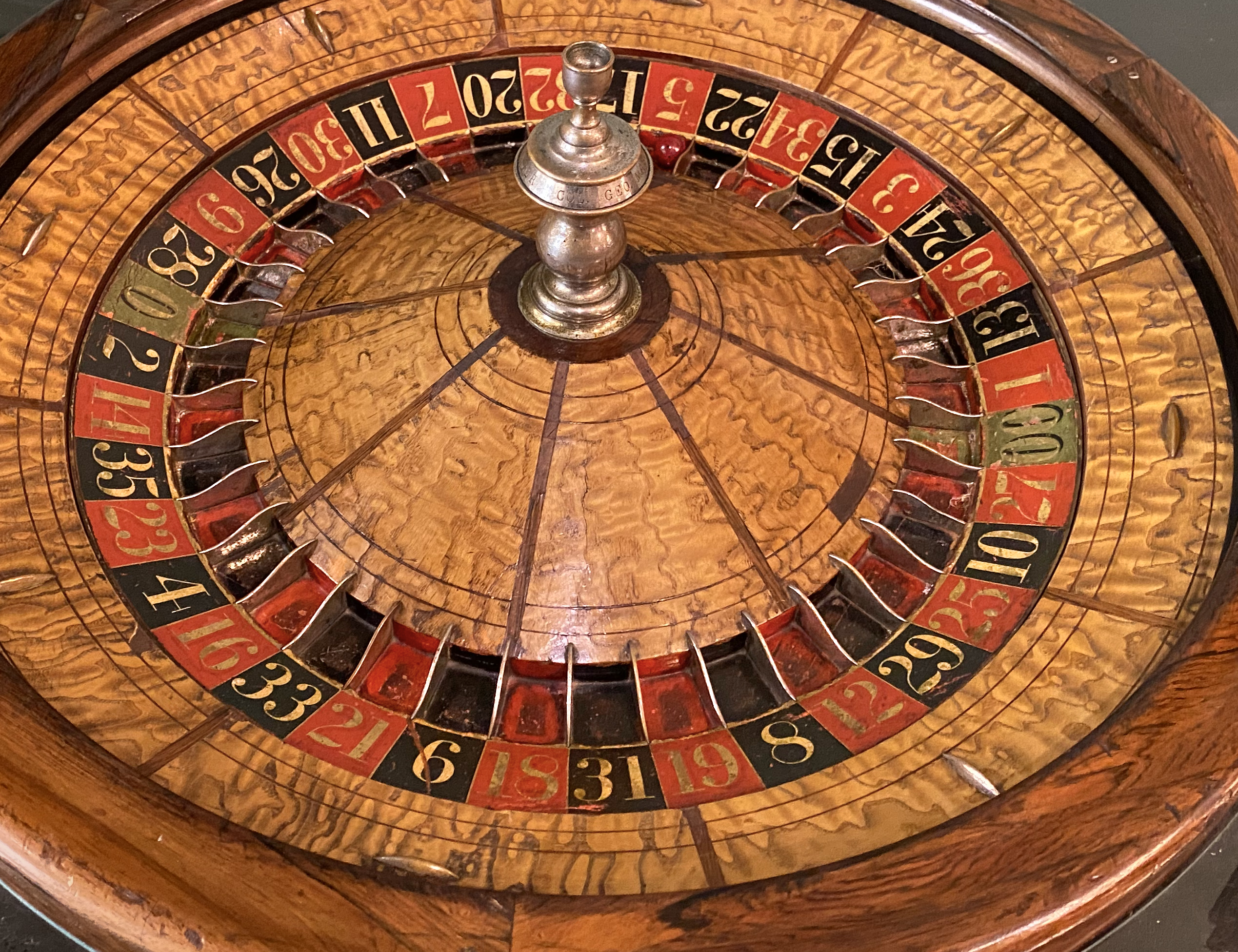
Figure5.3.3.19th century roulette wheel
In the casino game of roulette, a ball is dropped into a spinning wheel. Gamblers win or lose varying amounts based on where it stops. The payouts listed by the casinos and online are the net payouts, already take into account the money spent on the bet. In other words, we will calculate the expected value directly. Find the expected value of each bet.
Bet $4 on the number 15. The player puts their chips on the square with the number 15, and they win only if the roulette ball lands on 15. This bet pays 35 to 1.
Bet $10 on 1 to 18. The player puts their chips on the box that says "1 to 18", and they win if the ball lands on any number between 1 and 18, inclusive. This bet pays 1 to 1.
Bet $20 on a square. The player puts their chips on the corner where the squares 1, 2, 4, and 5 meet, and they win if the ball lands on any of those numbers. This bet pays 8 to 1.
Solution.
The probability of winning is \(\frac{1}{38}\) since there are 38 numbers on the wheel (1 through 36, plus 0 and 00). If the player wins, they receive \(35\) times their bet of \(\$4\text{,}\) or \(\$140\text{.}\) If they lose, they lose their $4 bet. The expected value is:
Therefore, if they play this bet repeatedly, they should expect to lose an average of about $0.21 per play on this bet.
The probability of winning is \(\frac{18}{38}\) since there are 18 numbers between 1 and 18, inclusive. If the player wins, they receive \(1\) times their bet of \(\$10\text{,}\) or \(\$10\text{.}\) If they lose, they lose their $10 bet. The expected value is:
Therefore, if they play this bet repeatedly, they should expect to lose an average of about $0.53 per play on this bet.
The probability of winning is \(\frac{4}{38}\) since there are 4 numbers in the square. If the player wins, they receive \(8\) times their bet of \(\$20\text{,}\) or \(\$160\text{.}\) If they lose, they lose their $20 bet. The expected value is:
Therefore, if they play this bet repeatedly, they should expect to lose an average of about $1.05 per play on this bet.
Expected value is not only used to determine the average amount won and lost at casinos and carnivals, it also has applications in business and insurance, just to name a few. Let’s look at a couple of those applications.
Example5.3.4.
For 3 months, a coffee shop tracked their morning sales of coffee, between 6am and 10am. The following results were recorded:
Number of cups sold
145
150
155
160
170
Probability
0.15
0.22
0.37
0.19
0.07
How many cups of coffee should they expect to sell each morning?
Solution.
In this case the table tells us that 15% of the time they sell 145 cups of coffee between 6am and 10am, 22% of the time they sell 150 cups, 37% of the time they sell 155 cups, 19% of the time they sell 160 cups, and 7% of the time they sell 170 cups. Since the highest probability is associated with 155 cups, the expected value should lie somewhat close to this.
To find the expected number of coffees sold, we multiply each number of cups of coffee by its respective probability and then add the products.
\begin{align*}
\text{Expected number of coffees sold}\amp=145(0.15)+150(0.22)+155(0.37)+160(0.19)+170(0.07)\\
\amp=154.4\text{ cups of coffee}
\end{align*}
This means that over the long run, the coffee shop can expect, on average, to sell around 154 cups of coffee each morning. This is an important tool for businesses since it helps inform them how much stock they should keep on hand.
Example5.3.5.
On average, a 40-year-old man in the US has a 0.242% chance of dying in the next year 1
. An insurance company charges $275 annually for a life insurance policy that pays a $100,000 death benefit. What is the expected value for the insurance company on this policy?
Solution.
The first thing we want to do is organize the probabilities and outcomes in a probability distribution table. There are two outcomes – either the policy holder dies, and the insurance company pays the benefit, or the policy holder does not die, and they do not pay anything.
The probability of paying the death benefit is equal to the chance of the person dying in the next year, and the probability of paying nothing is equal to the complement of the chance of dying in the next year.
So, the expected payout for the insurance company is $242, but they are charging $275 for the policy. Their net revenue would be
\begin{gather*}
\text{Net Value to Insurance Company}=\$275-\$242=\$33
\end{gather*}
The insurance company is making, on average, $33 per policy per year. It shouldn’t be too surprising because there are overhead costs and the insurance company can only afford to offer policies if they, on average, make money on them. But how much money should they make? As a consumer it is important to know about expected value.
Exercises5.3.2Exercises
1.
A bag contains 3 gold marbles, 6 silver marbles, and 28 black marbles. Someone offers to play this game: You randomly select on marble from the bag. If it is gold, you win $3. If it is silver, you win $2. If it is black, you lose $1.
Make a probability model for this game.
What is your expected value if you play this game?
2.
A bag contains 5 red marbles, 8 blue marbles, and 15 green marbles. Someone offers to play this game: You randomly select one marble from the bag. If it is blue, you win $3. If it is red, you win $2. If it is green, you lose $1.
Make a probability model for this game.
What is your expected value if you play this game?
3.
A friend devises a game that is played by rolling a single six-sided fair (each side has equal probability of landing face up, once rolled) die once. If you roll a 6, he pays you $3; if you roll a 5, he pays you nothing; if you roll a number less than 5, you pay him $1.
Make a probability model for this game.
Compute the expected value for this game.
Should you play this game?
4.
A friend devises a game that is played by rolling a single six-sided fair (each side has equal probability of landing face up, once rolled) die once. If you roll a 1, he pays you $5; if you roll a 2, he pays you nothing; if you roll a number more than 2, you pay him $2.
Make a probability model for this game.
Compute the expected value for this game.
Should you play this game?
5.
A company wants to offer a 2-year extended warranty in case their product fails after the original warranty period but within 2 years of the purchase. They estimate that 0.7% of their products will fail during that time, and it will cost them $350 to replace a failed product. If they charge $48 for the extended warranty, what is the company’s expected profit or loss on each warranty sold?
6.
A company wants to offer a 3-year extended warranty in case their product fails after the original warranty period but within 3 years of the purchase. They estimate that 0.5% of their products will fail during that time, and it will cost them $400 to replace a failed product. If they charge $60 for the extended warranty, what is the company’s expected profit or loss on each warranty sold?
7.
An insurance company estimates the probability of an earthquake in the next year to be 0.0013. The average damage done by an earthquake it estimates to be $60,000. If the company offers earthquake insurance for $100, what is their expected value of the policy?
8.
An insurance company estimates the probability of a flood in the next year to be 0.0002. The average damage done by a flood is estimated to be $70,000. If the company offers flood insurance for $3000, what is their expected value of the policy?
9.
You purchase a raffle ticket to help out a charity. The raffle ticket costs $5. The charity is selling 2000 tickets. One of them will be drawn and the person holding the ticket will be given a prize worth $4000. Compute the expected value for this raffle.
10.
You purchase a raffle ticket to help out a charity. The raffle ticket costs $10. The charity is selling 1000 tickets. One of them will be drawn and the person holding the ticket will be given a prize worth $3000. Compute the expected value for this raffle.
11.
At the local fair there is a game in which folks are betting where a chicken will poop on a 5 by 5-foot grid. (There are 25, 1 by 1 squares to choose from) You can buy a 1 by 1-foot square for $10 and if the chicken poops on your square you win $100. Find the expected value for this game.
12.
At the local fair there is a game in which folks are betting where a chicken will poop on a 4 by 4-foot grid. (There are 16, 1 by 1 squares to choose from) You can buy a 1 by 1-foot square for $15 and if the chicken poops on your square you win $125. Find the expected value for this game.
13.
Create a problem using the concept of expected value. Possible topics include insurance policies, financial decisions, gambling and lotteries. Determine the expected value of the situation you created.